‘Terminator 2: Judgment Day’ at 35
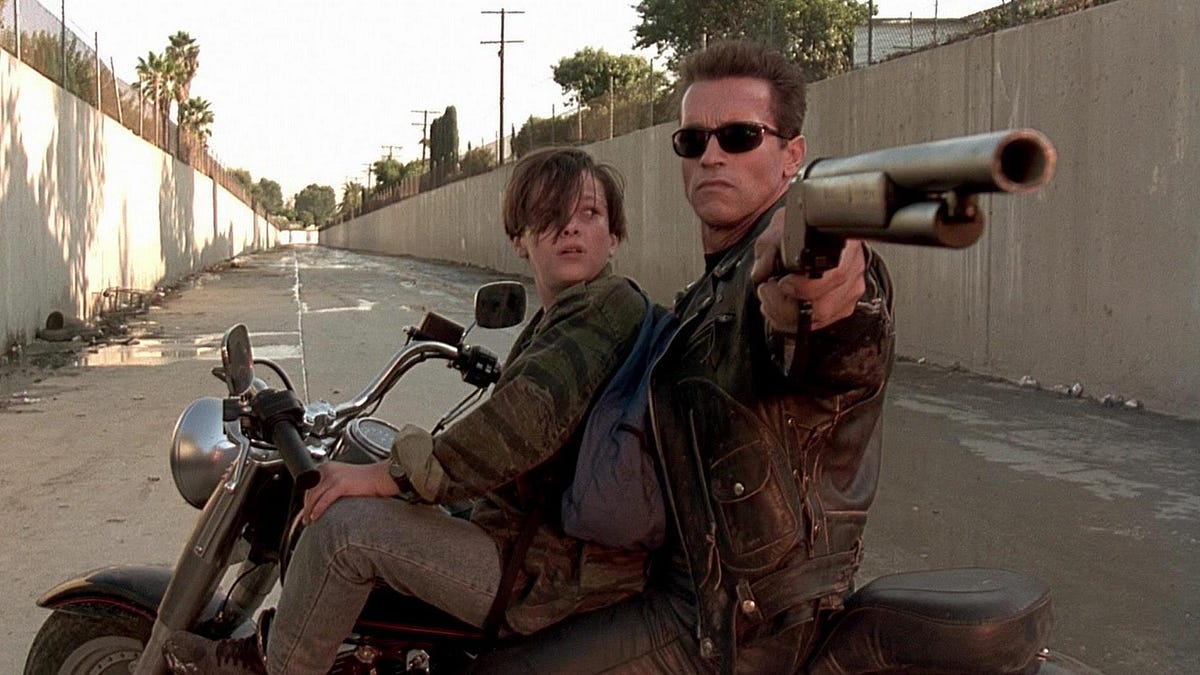
‘Terminator 2: Judgment Day’ at 35 The classic returns to theaters . . . kinda. Terminator 2 opens with a series of dissonant shots. The first sequence, backed by a down-tuned techno drone, is a shot of Los Angeles rush hour traffic. The present, or at least close to the present of 1991, when the film was released. Heat lines bake off the pavement. People scurry across the street. Kids swing on a playground overlooking the city and the swinging goes into slow motion and the screen’s exposure … goes … white. Cut to an eerie silence. It’s now 2029, nighttime, and the only word for what we see is devastation. Those cars are husks. The playground shattered. Skulls litter the ground, stacked almost too neatly. “Three billion human lives ended on August 29, 1997. The survivors of the nuclear fire called the war Judgment Day.” These are the words of Sarah Connor (Linda Hamilton), and her voiceover efficiently sets the stakes for those who happened to miss James Cameron’s 1984 classic, The Terminator. Robots sent back in time; human saviors to be born and nurtured and, possibly, killed; a fate to be avoided. This is the world we’ve been thrust into. The world of The Terminator and T2: Judgment Day is nominally about the terror of technology: the oncoming, unstoppable future unleashing manmade horrors beyond comprehension. In The Terminator, this horror is not a robot that looks like a man but nuclear annihilation, an all-too-real fear for the people living in 1984 under the shadow of thousands of nukes ready to launch at a moment’s notice. By 1991, the tech has evolved and there’s an inkling of the difficulties presented by computers, neural networks, learning machines, and such. But the real problem is, always, people. The people who build the machines, the people whose politics lead inexorably to self-annihilation, even the kids who shoot at each other with toy guns. “We’re not gonna make it, are we?” John Connor (Edward Furlong) asks his Terminator protector (Arnold Schwarzenegger) while watching those playfully murderous scamps in T2. The cyborg frowns. “It is in your nature to destroy yourselves.” Terminator 2: Judgment Day is a perfect movie—expertly blending action, comedy, and visual fluidity in a way that keeps the film moving while probing questions beyond the depth of the average blockbuster—and since it’s now thirty-five years old, it doesn’t exactly need a review. If you’ve never seen it, you should. Even if you can’t really see the movie as it was released any longer. There’s a superficial irony in Hollywood’s premier auteur of future-terror being the most tech-forward filmmaker: No one alive has done more than James Cameron to push the frontiers of filmmaking. From digital filming to CGI to 3D to high frame rate, Cameron believes in using all tools available to push forward the state of filmmaking, to bring audiences the most epic sights and sounds imaginable, to pull them into the screen. And yes, this includes advances tied to artificial intelligence, which has led to near-infinite versions of the same joke being deployed on social media: “James Cameron wants to use AI? Hasn’t he even seen the Terminator films?” Nyuk nyuk. The use of AI in filmmaking and the fine distinctions between generative AI, AI-assisted machine learning, and what amounts to gussied-up CGI, are beyond the scope of this essay; suffice to say that the point of the Terminator films is not that AI, per se, is bad, but that humans are poor stewards of any sufficiently advanced technology, from nuclear weapons to autonomous machines designed to deliver them. “No fate but what we make” isn’t a line about launch codes; it’s a line about people. People, as always, are the problem. And Terminator 2 is absolutely a film that demonstrates the peril of people given too much technology to play with. Support our growing coverage of movies, books, arts, ideas, and culture—become a Bulwark+ member today: Cameron is an inveterate tinkerer, and over the years a variety of tools have been developed that allow him to fidget with his films. Physical media collectors (guilty, your honor) are more aware of Cameron’s predilection than most, because we spend a great deal of time kvetching about all the ways he’s mucked with his movies over the years. Sometimes this tinkering works out nicely; The Abyss is one of the best-looking 4K UHD discs I’ve ever seen, an immaculate restoration with little of Cameron’s usual futzing. The 4K of The Terminator was a bit more controversial, at least in part because there seems to have been some reduction of the film grain, but I thought it looked fine. The real crime was True Lies, which used and abused AI in a way that made actors we know and love like Arnold, Jamie Lee Curtis, and, uh, Tom Arnold, look like Uncanny Valley recreations. The 4K transfer of T2 (which is, reportedly, the version playing in theaters this weekend; I have not seen it, though, so I cannot say this for certain) is a fascinating bundle of technological contradictions. On the one hand, Cameron was able to use CGI to make some fixes that have, clearly, bothered him for years, like replacing Arnold’s double’s face in a couple of motorcycle stunts with Arnold’s actual face. The contrast and color grading look great, if a little bluer than the original release. But the faces. The faces are so smooth, free of pores. And this is because his technological wizards turned the noise reduction up to 11. Without getting tediously technical, film is a physical product and the process of creating the moving image whizzing by your eyeballs at twenty-four frames per second introduces random imperfections. James Cameron hates film grain. He wants it gone. And through various digital processes, you can make it gone. But making it gone inevitably reduces the total amount of information in the image. Hence the waxy faces, the porcelain-doll effect. Everything looks clear but flat. The existence of the tool isn’t the problem. Using the tool, knowing the limits of the tool: That’s the issue. Terminator 2 tells us we have no fate but what we make. But the actual, physical product of Terminator 2 shows us that our best and brightest seem to make the same mistakes over and over again. If we never choose a different path—if we can never choose a different path—is it truly that different from fate? Ultimately, this is a discussion about the future and who has a claim to it. On one side you have Cameron, who surely has the right to muck with his movie as much as he likes. He can eliminate as much grain as he likes; he can cut Arnold’s face off one image and plaster it onto another; he can probably use AI to make the lips of the actors sync up with foreign dubs, if he wants. He has the right to tinker.1 But what responsibility does he have to future generations who might want to see the movie as it looked on original release? I’m in this cohort myself. I was eight when T2 was released, so I missed its initial theatrical run. Over the years I’ve watched it on grainy VHS, standard-def HBO feeds, and, probably closest to its true form for home video, on DVD. I skipped the Blu-ray releases since I’d heard terrible things about the color timing (for some reason the tinkerers love blue tints: see also Mann, Michael) and had held off on the 4K until this week in the hopes that we might get something closer to a proper restoration. Alas. Maybe one day I’ll get to see it as it was projected in 1991; I imagine Quentin Tarantino has a vintage print somewhere in the bowels of the New Beverly Cinema. Maybe I’ll get to see it that way one day. This is the eternal tension between the tinkerers and the preservationists, the artists who rightfully want perfection on their own terms and those of us who think that something is lost when we jettison the historical markers of cinema past for a variety of eternal now. There’s no fate but what we make. The question is who gets to make it—and for whom. Some of my favorite filmmakers are inveterate tinkerers: Ridley Scott, Michael Mann, David Fincher, and, of course, George Lucas. Rumor has it that for the fiftieth anniversary of A New Hope—a name that is itself a tinker—we’re going to get the original theatrical cut of the film rereleased in theaters, albeit one with the THX tinkers that all of us with the VHS box set remember. Fingers crossed.
~6 min read · 1445 words